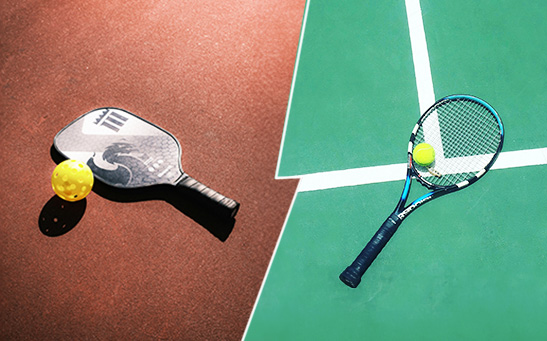
Pickleball and tennis share several similarities. Both involve a net, a ball, a playing court and players competing to outscore their opponents. However, the two sports have important differences in court dimensions, equipment, serving techniques, scoring systems and gameplay.
Pickleball has gained attention because it is relatively easy to learn and can be enjoyed by people of different ages and skill levels. Tennis, meanwhile, has a longer history and demands a combination of power, stamina, technique and court coverage.
So, which sport is easier to play? Is pickleball less physically demanding than tennis? Can tennis players switch to pickleball without learning everything from scratch?
This guide to pickleball vs tennis explains 10 key differences to help beginners and experienced players understand both sports.
Pickleball vs Tennis: Quick Comparison
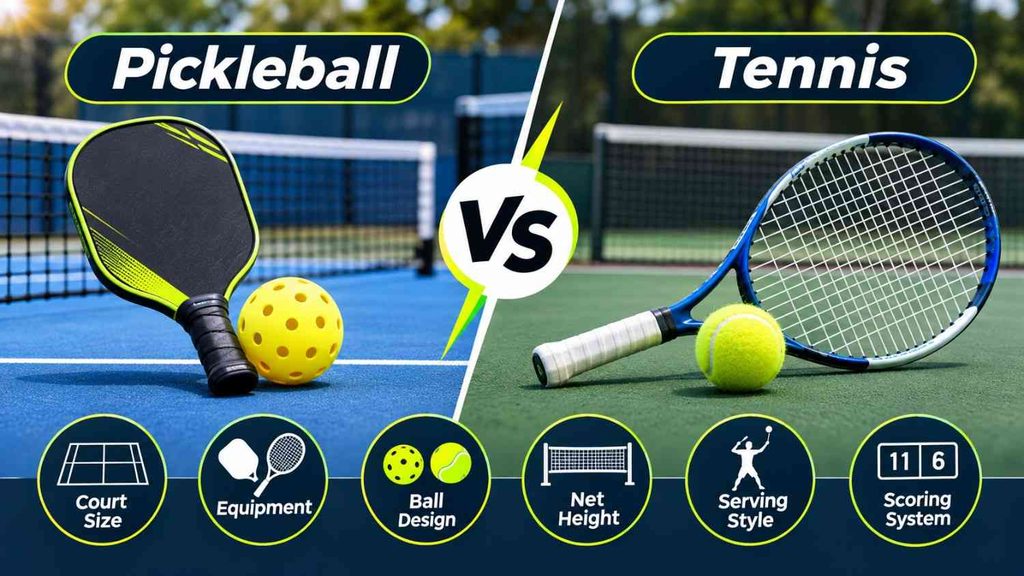
Here is a quick overview of how pickleball and tennis compare across their main features.
| Feature | Pickleball | Tennis |
| Court size | 20 × 44 feet | 27 × 78 feet for singles |
| Doubles court | 20 × 44 feet | 36 × 78 feet |
| Equipment | Solid paddle | Strung racket |
| Ball | Perforated plastic ball | Felt-covered rubber ball |
| Net height at centre | 34 inches | 36 inches |
| Serving style | Underhand or drop serve | Overhand serve |
| Special rule | Two-bounce rule | No equivalent rule |
| Restricted area | 7-foot kitchen | No kitchen |
| Standard scoring | Usually 11 points | Games, sets and matches |
| Common format | Singles and doubles | Singles and doubles |
The measurements and playing rules are based on the standards published by USA Pickleball and the International Tennis Federation (ITF).
10 Key Differences Between Pickleball and Tennis
1. Court Size and Dimensions
The biggest difference between pickleball and tennis is the size of the playing court.
A standard pickleball court measures 20 feet wide and 44 feet long. These dimensions remain the same for both singles and doubles matches.
A tennis court is considerably larger. It measures 78 feet long, with a width of 27 feet for singles and 36 feet for doubles.
This difference affects how players move and approach each rally. Pickleball requires less overall court coverage, while tennis involves more running, positioning and movement across the baseline.
| Court measurement | Pickleball | Tennis |
| Length | 44 feet | 78 feet |
| Singles width | 20 feet | 27 feet |
| Doubles width | 20 feet | 36 feet |
A tennis court can also accommodate multiple pickleball courts when properly marked and equipped with suitable nets. However, the number that fits depends on the available surrounding space and facility layout.
2. Equipment: Paddle vs Racket
Pickleball and tennis use different equipment, although both sports require players to strike a ball over a net.
In pickleball, players use a solid paddle. It usually has a flat hitting surface made from materials such as composite, graphite or carbon fibre. The paddle has no strings.
Tennis players use a racket with a framed head and a string bed. The strings help generate power, spin and control when hitting the ball.
The equipment also affects playing technique. Pickleball relies heavily on paddle control and precise placement. Tennis allows players to generate more racket head speed and use a wider range of powerful strokes.
3. Ball Design and Bounce
The balls used in these sports are noticeably different.
A pickleball is made from lightweight plastic and contains between 26 and 40 holes. Its design affects how it moves through the air and how it bounces on the court.
A tennis ball has a rubber core covered with felt. It is designed to produce a higher bounce and supports the faster, more powerful style of tennis.
These differences influence the pace of a rally. Pickleball often involves controlled shots, short exchanges and careful placement. Tennis produces a different combination of speed, spin and bounce.
4. Net Height
Net height is another important difference.
A pickleball net measures 36 inches at the sidelines and 34 inches at the centre. A standard tennis net measures 42 inches at the posts and 36 inches at the centre.
The lower pickleball net changes the angles players can use when returning shots. It also influences how players approach the kitchen and execute soft shots near the net.
Although the difference at the centre is only two inches, it contributes to the distinct playing styles of both sports.
5. Serving Rules and Techniques
Serving is one of the most noticeable differences between pickleball and tennis.
In pickleball, the standard volley serve must follow specific restrictions. Players strike the ball using an upward paddle motion, with contact below waist height and the paddle head below the wrist. Players can also use the permitted drop serve.
The serve must travel diagonally into the opposite service area and clear the kitchen.
Tennis uses an overhead serving technique. Players toss the ball into the air and strike it before it touches the ground. They can use different combinations of speed, spin and placement to challenge their opponents.
Another difference is the number of serving attempts. Tennis normally allows two serves per point, while pickleball generally allows one serving attempt.
6. The Two Bounce Rule
The two-bounce rule is unique to standard pickleball gameplay.
After a pickleball serve, the receiving team must allow the ball to bounce before returning it. The serving team must then allow the return to bounce before hitting it.
Once these two bounces have occurred, players can volley the ball or allow it to bounce before returning it.
Tennis has a smaller version of this restriction. The receiver must let the serve bounce once before returning it — volleying a serve is not allowed. After the return, however, both players can volley freely at any time.
This difference gives pickleball its own rhythm and prevents players from rushing directly towards the net immediately after serving.
7. The Kitchen or Non-Volley Zone
The kitchen is one of the most recognisable features of pickleball.
It is a seven-foot area on each side of the net. Its official name is the non-volley zone. Players cannot hit the ball out of the air while standing inside this area.
They can enter the kitchen to play a shot after the ball bounces. However, they must ensure that their momentum does not carry them into the zone while completing a volley.
Tennis has no equivalent restriction. Players can move close to the net and hit volleys without worrying about a designated kitchen area.
This rule makes pickleball more tactical. Players often use soft shots called dinks to move opponents out of position and create opportunities to attack.
8. Scoring System
Pickleball and tennis follow completely different scoring systems.
In traditional pickleball, a game is usually played to 11 points. A player or team must win by at least two points. Under standard side-out scoring, only the serving team can score.
Doubles players also announce three numbers when calling the score. These represent the serving team’s score, the receiving team’s score and the server number.
Tennis uses a more detailed scoring structure. Points progress through 15, 30 and 40, followed by game point. If both players reach 40, the game goes to deuce. A player must then establish a two-point advantage to win.
Tennis matches are generally organised into games and sets, with the winner determined by the required number of sets.
9. Gameplay, Speed and Physical Demands
Both sports require quick reactions, good coordination and accurate shot placement. However, their physical demands differ.
Pickleball generally involves less court coverage because of its smaller playing area. Doubles matches often feature quick exchanges near the kitchen, where players rely on reflexes, balance and control.
Tennis requires players to cover a much larger area. They regularly move forwards, backwards and sideways while responding to powerful serves and groundstrokes.
This makes tennis particularly demanding in terms of running endurance and repeated movement over longer distances.
However, pickleball should not be considered a physically effortless sport. Competitive matches can involve rapid reactions, repeated lunges and demanding exchanges close to the net.
The physical intensity of either sport depends on the player’s fitness, playing style, match length and competition level.
10. Accessibility and Learning Curve
Pickleball is often easier for beginners to pick up because of its smaller court, lighter equipment and simpler basic scoring system.
New players can start with basic shots and gradually develop skills such as dinking, serving and volleying.
Tennis generally requires more time to develop consistent serving, groundstrokes, footwork and ball control. Its larger court also requires players to learn how to position themselves effectively.
However, tennis players already have several transferable skills when switching to pickleball. Hand-eye coordination, net play, positioning and understanding of spin can help them adapt.
Both sports welcome beginners, recreational players and competitive athletes. The better choice depends on individual interests, fitness levels and playing preferences.
Which Is Better: Pickleball or Tennis?
There is no universal winner when comparing pickleball and tennis. Both offer different playing experiences and benefits.
Pickleball may be a better choice if you:
- Want a sport with relatively simple beginner rules.
- Prefer a smaller playing court.
- Enjoy doubles and social games.
- Want to focus on control, placement and quick reactions.
- Have limited experience with racket sports.
Tennis may be a better choice if you:
- Enjoy fast serves and powerful groundstrokes.
- Prefer covering a larger playing area.
- Want to develop advanced racket skills.
- Enjoy longer matches and physical challenges.
- Prefer traditional singles and doubles competition.
The best approach is to try both sports before making a decision. You may find that pickleball suits your recreational interests, while tennis offers a more challenging competitive experience.
Can Tennis Players Easily Switch to Pickleball?
Yes. Tennis players can often adapt to pickleball more quickly than complete beginners because several skills transfer between the sports.
Their experience with serving, returning, volleys, court positioning and reading opponents can provide a useful starting point.
However, pickleball requires some adjustments. Tennis players must learn the kitchen rules, two-bounce rule and different serving techniques. They also need to control their shots rather than relying on powerful groundstrokes.
The smaller court and solid paddle create a different playing experience. With regular practice, experienced tennis players can develop the touch and positioning needed to become effective pickleball players.
Conclusion
The comparison of pickleball vs tennis shows that both sports have their own advantages. Pickleball offers a smaller court, solid paddles, simpler scoring and unique rules such as the kitchen and two-bounce rule. Tennis focuses more on powerful strokes, larger court coverage, overhead serving and traditional game and set scoring.
Pickleball can be a great starting point for beginners, while tennis offers a different physical and technical challenge. Ultimately, the right choice depends on your interests, fitness goals and preferred style of play.
Frequently Asked Questions
Yes, pickleball is generally easier for beginners to learn. Its smaller court, lighter equipment and simpler basic scoring system make it more accessible. However, becoming an advanced player still requires practice and skill.
Yes. A tennis court can be adapted for pickleball using temporary lines and suitable nets. Multiple pickleball courts can fit within the available tennis court space, depending on the layout and safety clearance.
Generally, tennis requires more running and overall court coverage. Pickleball involves less movement across the court but still demands quick reactions, balance and agility, particularly during competitive doubles matches.
No. Pickleball requires a solid paddle rather than a traditional tennis racket. The paddle and perforated plastic ball are specifically designed for pickleball gameplay.
5. Why is pickleball becoming popular?
Pickleball is attracting players because it is relatively easy to learn, requires limited equipment and offers an enjoyable social playing experience. Its smaller court also makes it suitable for different age groups and skill levels.
